 Chaire UNESCO Alimentations du monde
Despite growing evidence for the multiple health benefits of community gardening, longitudinal studies based on quantitative data are needed. Here we describe the protocol of JArDinS, a quasi-experimental study, aimed at assessing the impact of community garden participation (a natural experiment) in the adoption of more sustainable lifestyles.
Accueil > Mots-clés > Langue > Anglais
Anglais
Articles
-
 Does participating in community gardens promote sustainable lifestyles in urban settings ? Design and protocol of the JArDinS study.
10 novembre 2021, par Mathilde COUDRAY -
 The new nutrition science project
27 octobre 2021, par Mathilde COUDRAYTo show that nutrition science, with its application to food and nutrition policy, now needs a new conceptual framework. This will incorporate nutrition in its current definition as principally a biological science, now including nutritional aspects of genomics. It will also create new governing and guiding principles ; specify a new definition ; and add social and environmental dimensions and domains.
-
 A conceptual model of the food and nutrition system
27 octobre 2021, par Mathilde COUDRAYThe integrated model developed here included three subsystems (producer, consumer, nutrition) and nine stages (production, processing, distribution, acquisition, preparation, consumption, digestion, transport, metabolism). The integrated model considers the processes and transformations that occur within the system and relationships between the system and other systems in the biophysical and social environments. The integrated conceptual model of the food and nutrition system presents food and nutrition activities as part of a larger context and identifies linkages among the many disciplines that deal with the food and nutrition system.
-
 The governance of city food systems : case studies from around the world
23 novembre 2021, par Mathilde COUDRAYThis book brings together eight papers on the governance of city food systems. As case studies, they examine the governance of city food systems in Milan, Belo Horizonte, Vancouver, Edinburgh, Bristol, Bangkok, Jakarta and Singapore.
-
 Guidelines on food fortification with micronutrients
3 novembre 2021, par Mathilde COUDRAYThe guidelines are written from nutrition and public health perspective, to provide practical guidance on how food fortification should be implemented, monitored and evaluated. They are primarily intended for nutrition-related public health programme managers, but should also be useful to all those working to control micronutrient malnutrition, including the food industry.
-
 Limited food availability
3 novembre 2021, par Mathilde COUDRAYWhile food security is a major worldwide issue, it is a much more serious problem in Low-Income
(LI) and Lower Middle-Income (LMI) countries. Currently, sub-Saharan Africa is the sub-continent with the highest proportion of undernourished people, the largest gap between current and potential yields, and between cereal consumption and production. Looking to the future, population growth and climate change may worsen the situation, particularly in Africa. African countries are still facing rapid population growth with uncertain prospects about the ability of their agriculture to meet growing food demand. In addition, without sufficient adaptation measures, climate change will negatively impact food production in most African regions. -
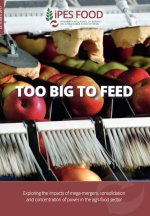 Too big to feed. Exploring the impacts of mega-mergers, consolidation and concentration of power in the agri-food sector
26 octobre 2021, par Mathilde COUDRAYWhat is corporate concentration, why does it matter for food security, and who are the biggest corporate players in each agrifood sector/"link" in the Industrial Food Chain ?
-
 The new science of sustainable food systems : overcoming barriers to food systems reform
27 octobre 2021, par Mathilde COUDRAYTo accelerate the shift towards sustainable food systems, a new science of sustainable food systems is needed. This paper traces out the contours of a new analytical framework for sustainable food systems (Section 1). It then describes the principles of transdisciplinary science that must be applied in order to generate the types of knowledge that can support the transition to sustainable food systems (Section 2). Finally, it considers previous and ongoing attempts to address sustainable food systems at the interface of science, policy and practice, in order to identify where initiatives have succeeded, where challenges remain, and how these energies can be harnessed and combined to support the transition to sustainable food systems (Section 3).
-
 Beacons of hope : accelerating transformations to sustainable food systems
23 novembre 2021, par Mathilde COUDRAYThis report examines 21 initiatives that are working to achieve sustainable, equitable, and secure food systems.
-
 2021 / Seminar - Impact assessment of food innovations
2 février 2021, par Mathilde COUDRAYSustainable food system innovations are multiplying around the world. In order to better understand these food innovations and how they influence the sustainability of food systems, multiple impact assessment methods have emerged. During the seminar, different evaluation methods will be presented through five projects.